Thursday, 13 March 2014

A New Angle - Cubism

Cubism was a new innovative experimental art movement, pioneered by artists such as Picasso and Georges Braque. It explores both the human form and objective forms from different angles and creates a fractured, abstract image build of shard like forms with images of an object from different angles, almost as if it has been shattered and pieced back together. It's highly regarded as one of the most influential, if not the most influential art movement of the last century, as it gave artists a new way to think about their artwork, leading into far more complex movements such as surrealism. It has influenced fashion too; many designers have looked into the different ways we see the body and have taken the typical shapes and abstracted them to give new silhouettes.

(Source: burgessart.wordpress) One of Picasso's cubist works - he had quite a few cubist styles, and this one is far more analytic than experimental. It captures the person so you can tell that they are indeed a person, but disjoints and fractures the image to give a sense of movement.

(Source: artyfactory.com) Picasso's famous 'Weeping Woman' - you can see the major differences in the two images - this one is extreme abstractionism, and in this case the cubism fractures give her an entirely broken look, as if her emotions are projected directly onto her form.

Cubism is one of my favourite art movements because I strongly feel it almost forces you to look at something from a new perspective, allowing you to break through any restrictions you had about it before - you'll notice something new, and from that you can gain new inspirations and new creative techniques.

Hooray for Hollywood

In today's world, Hollywood is one of the main places to look for trends aside fashion week, with actresses becoming style icons and millions of young admirers copying their styles and sparking off worldwide trends. The 20's was the time in which this came about - screen sirens showcased the new feminine style and the elements that made it up, be it hair and makeup, the silhouette or the garments worn.

(Source: xojane.co.uk) Screen Siren Theda Bara with her signature 'Vamped' look - heavily rimmed with kohl, attention is directly on the eyes and makes them really pop - which is good as they are simply stunning.


From the Hollywood (or Hollywoodland as it was called at the time) scene came a new beauty trend which would be worn by the majority of trend-conscious young women at the time - the 'Vamped' look. Two screen stars in particular, Theda Bara and Pola Negri set in motion the trend for eye makeup, and so a vampiric look with coal-dark eyes and just bitten lips became the height of fashion - a dramatic and strong look focusing in on the eyes, it used accessories such as ribbons or fringes to conceal the forehead and bring attention down to the eyes.


(Source: polanegri.pl) A slightly more toned down look compared to Bara's, it is darkly ethereal and the lips are a gorgeous dark shade.

Draping was now extremely popular, but Hollywood also provided a platform for Madeline Vionnet with her bias cut creations. The shape flowed around and emphasised the female form, and as it grew in popularity many started to take inspiration from cubism.
(Source: emblah13.wordpress) Screen Siren Irene Castle wearing Vionnet - The draping shows off her form so well and exposes just the right amount of flesh

The New Man

Like the new carefree woman, men also grew more casual towards things. Their clothes became casual - straw boaters and softly tailored suits became a huge trend, and so did driving fast cars - racing their cars around the country, towns and cities was a huge past time, as well as drinking cocktails and partaking in sports activities (a huge statement to show you were part of the 'it crowd as sportswear was becoming increasingly popular). The new man was a brilliant counterpart to the new type of woman appearing, and together men and women in society led their own, fun and happy lives in this new place of hope.


(Source: pinterest) The relaxation of Men's fashion in the 20's - I think the trousers tucked into the socks is a winning look as it makes the silhouette look so interesting and also injects a boost of pattern and colour into the outfit.


(Source:vintage.es) Young men racing their treasured cars in the mid- 20's.

Monday, 24 February 2014

A New Era; The Roaring Twenties

__


The war was a dramatic turn of events, and so reflecting this was the dramatic change of mood that came with the end of the war - years of sadness, hopelessness and struggle suddenly turned to hope and the want to live life to the full; people were finally beginning to look forward. 


(Source: zazzle.com) 'Afternoon Play' by George Barbier - I really enjoy looking at his work because I think it captures the nature of the entire decade so well - everyone seems so free and content in his images. It's quite a simplistic style of drawing but with a modern feel, as everyone was looking forward to new and exciting things.
#
(Source: weheartit.com) 'The Fireworks' by George Barbier - he often depicted different types of couples in love, such as the sporty types (below) or the socialites (above). It reflected upon the positive feelings of the 20's and the love people were sharing after the devastation of the war.
(Source: pinterest) 'Lovers in the Snow' by George Barbier.

People wanted to feel young again in this new time, and designers and artists were picking up on that, so they found new ways of making art, freer clothes and leisure spaces and in general the world was creating a new way of living with new attitudes and values.
(Source: V&A) One of Victor Steibel's fashion designs - the silhouette has become more slick and streamlined, with futuristic design detailing such as the collar, and the free nature of the 20's is shown in the baring of flesh.

Everything became casual - a world away from the tight-lipped, corseted ways of the previous decades. Clothes and manners lost their formality, and people were finding and revelling in their own freedom; young people lived away from their parents, everyone was relaxing, showing off and having fun in a carefree way.


(Source: hairarchives.com)


(Source: tvtropes.org) Early versions of the flapper girls

Women were beginning to embrace this new sense of independence brought to them by the end of the war - they did what they wanted when they wanted without the rules of society or a man, as they would've in previous years. They would go to parties on their own, smoke in public, wear revealing clothes (hemlines had shot up), and embraced a whole new look - whilst before the hair was many curls piled high on the head, girls were now chopping away their locks and emphasising their natural beauty with makeup like never before! This trend skyrocketed and became the 'Flapper Girl' look  and lifestyle - the dictionary definitive of a flapper is "A young woman, especially one in the 1920s, who showed disdain for conventional dress and behavior." They were free, independent and the new definition of beautiful.


Victory Bells, Wedding Bells

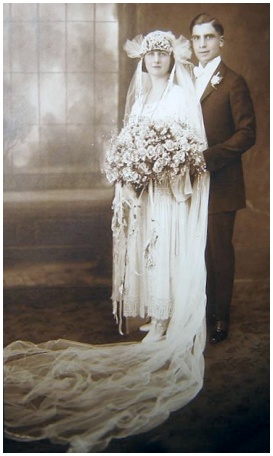
When the war was won, the whole world over was celebrating - the fashion industry became a booming market, especially in the wedding department - so many people were seizing the opportunity to get married and appreciate the lives they had that couture houses and other fashion manufacture's were soon selling tens upon thousands of wedding dresses; people were starting to be happy again, and this was leading into a far happier era.


(Source: fashionera.com)
 
(Source: padureya.com)
 
(Source: fashion-era.com)
 
I think it's brilliant that everyone was so uplifted by the end of the war that they chose to marry - these dresses are beautiful and it's so interesting to see the shortening hemlines and how it still looks so elegant and graceful.

Women of the War


During the war, so many men had joined the British forces that it brought a change upon British society which would last permanently, right up to current day! Women, who previously either didn't work at all, or worked doing sterotypically 'female' jobs such as staying at home to look after the children, in garment factories or a domestic servant. This all changed with the war - suddenly they were encouraged to work on farms and in hospitals, doing the men's work, and doing it well.

(source: firstworldwar.com) Women working in the factories - I love how this is such a great balance of the femininity and the harsh, dirty working environments they were in - women were becoming stronger, and not seen as just weak posessions, however they were still women - as you can see by the way they're wearing gloves and daintily handling the oily parts.
 
(Source: guim.co.uk) Munition workers in the factory handling arms.
 
(Source|: formerdays.com) American nurses during the Great War - they had such important jobs and this changed the perception of women forever
 
Men's styling was now widely accepted, due to the jobs which required practical clothing - women would now be wearing trousered garments such as boiler suits and dungarees to work - low heeled boots were also a working wardrobe staple.


(Source: fashionthroughtime.wordpress) Variations of the boiler and trouser styles

Another practical necessity was to support the bust. With the decline of the corset in full motion, bodices which were softer were introduced, as was the brassiere, a shorter and more developed version of the bust bodice.


(Source: wikipedia) A more developed version of the bust bodice; the brassiere. It looks far more relaxing than the traditional corset and bust bodice, allowing freedom of movement and the natural figure to shine through

Qui qu'a vu, Coco?

The trends for practical and functional clothing were the most prominent during the war, and there was one designer who would skyrocket to the forefront of fashion for her new and innovative way to create a new look which fit in with the trends - Gabrielle Chanel.


(Source: houseswithhistory.wordpress) Gabrielle 'Coco' Chanel - she had quite an elegant, grtaceful look to her face naturally, as her clothes did.

Sent to a convent as a child, she learned the art of sewing there and found employment as a seamstress after leaving school. However this was not her passion and she sought a career on stage - singing cabaret in cafes, during which she found her nickname 'Coco' from the song 'Qui qu'a vu Coco?'

http://www.youtube.com/watch?v=mGhwcodklwY A clip from the movie 'Coco before Chanel' based on Gabrielle Chanel's life - when she worked as a cabaret singer.


Her fashion career started in Milinery, when she opened her own store in Paris called Chanel Modes. In 1913 she opened her own store selling deluxe casual leisure clothes out of jersey, a material only used for men's boxers previously. The clothes were clean-cut and minimalistic, with simplistic and yet still chic shapes. The clothes were sporty and comfortable whilst still offering a feminine edge - the outfits were made mostly of two key pieces (such as a sailor blouse and skirt) in stretch fabrics to offer a contemporary, inexpensive take on clothes. She  was modernising fashion.

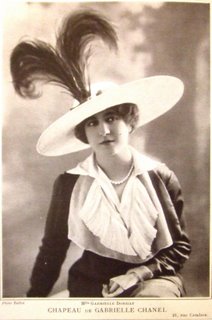
(Source: wikimedia) Gabrielle Dorziat wearing a Chanel hat - the shape is simple but the plumage of the feather adds an opulent detail for an outlandish luxurious look.


(Source: designboks.bk) To the far left you can see Coco Chanel wearing the iconic sailor blouse, which she pioneered and started a trend that would last for many years to come - in the middle Audrey Hepburn wears the breton stripes, as ia James Dean, in the far right. I love how this has evolved to become one of the staple items in any great capsule wardrobe, and is still popular today.

 Jersey went from being a heavily unused material to being THE material to use in fashion - nowadays we wear it on most casual clothes without even thinking about it but back then this material seemed luxe.


(Source:whatgoesaroundnyc.com) One of Chanel's jersey leisure suits; it's so relaxed but yet feminine at the same time, giving an altogether clean and elegant look.


(Source: evolutionbtg.blogspot) The iconic Chanel jersey tweed suit; it has become a timeless classic which has been reworked in so many ways, for example the co-ord trend which was so big in 2012/13 and especially in Lagerfeld's Chanel shows, in which he updates the look slightly to give a wearable, contemporary look.


(Source: fashionbombdaily.com) Karl Lagerfeld's take on the traditional Chanel suit.

Almost overnight more mainstream manufacturers were copying her styles for the wider public to wear - dressmaking patterns were released for her look, making it accessible to everyone; the chanel waif was taking over.


(Source: 1920s-fashion-and-music.com) An illustration for a Chanel inspired pattern in the 20's - everyone could wear the Chanel look, even if they couldn't afford it/

After the war in 1921, she collaborated with Ernest Beaux on her debut perfume, Chanel No.5. It is one of the biggest selling perfumes in the world and made Chanel one of the richest designers in history. She designed the bottle herself, inspired by a whiskey decanter at one of her former homes which she always said she wanted to recreate.

(Source: intheseams.com) - the original Chanel No.5 perfume bottle - it really does look like a whiskey decanter, and the perfume colour represents that too. A genius idea - take something iconic and make it a worldly known object. I salute you, Madame Chanel.